A world model behind every forecast.
Inside the tenth dot is the world we build for each question: actors, events and dependencies, held as beliefs that evidence moves by Bayes’ rule.
The world model
Inside the tenth dot is the world we build for each question: actors, events and dependencies, held as beliefs that evidence moves by Bayes’ rule.
Turn it around and an analyst draws out what it holds: the facts on record, and the hypotheses it weighs, each with a probability you can inspect.
Our researchers fine-tune models, run reinforcement-learning experiments, and evaluate how they reason about evidence and uncertainty.
Independent geopolitical intelligence
Geopolitical forecasts you can examine—not just accept. For investment, trading, and underwriting decisions.
Explore assessmentsRequest access01 / Why the tenth man
After the 1973 Yom Kippur War, Israel’s military intelligence created a small unit with an unusual brief: challenge the prevailing assessment, examine the unlikely scenario, and argue the other side. The principle is often called “the tenth man”: when nine people look at the same information and reach the same conclusion, the tenth must assume they are wrong and start digging.
We named the company after that obligation.
Disagreement for its own sake is just another bias. The tenth man’s job is to look, not to oppose.
A defined question, a probability, and the evidence on each side, so a view can be tested rather than simply trusted.
Every dated revision stays visible. When the consensus survives the test, you know why it holds.
02 / A view you can examine
A probability is a starting point, not the end of the conversation. Examine the question, its dated range, and how the assessment changes.
Illustrative public assessment
An assessment of whether all 21 APEC economies adopt a joint leaders' declaration at the Shenzhen meeting on 18–19 November 2026, shown as a public band with a dated history.
The interactive walkthrough lets you compare your own call with the published band. Nothing you choose is submitted.
Browse the public library03 / How we work
Every assessment runs the same loop: frame the question, test it against the contrary case, commit to a range, follow the consequences, and keep the record.
Know exactly what a probability refers to. Defined events, decision windows, and resolution rules make the assessment something you can revisit—not a vague outlook.
Inspect source evidence and how it supports or challenges an outcome. Separate the information from the interpretation, then bring your own judgment.
Publish a stated probability range with its reasoning, rather than a verdict. Your team can inspect the assumptions and weigh the assessment against its own exposure.
Explore linked upstream and downstream questions. Distinguish the initial event from the responses and consequences that matter to your decision.
We refine the model through fine-tuning, reinforcement learning and evaluation. Published assessments retain their dated record.
04 / Historical context
A border opens. A system is shaken. A trade route stops. These three moments offer questions for examining exposure—not evidence that the next event will follow the last.
· Berlin, Germany
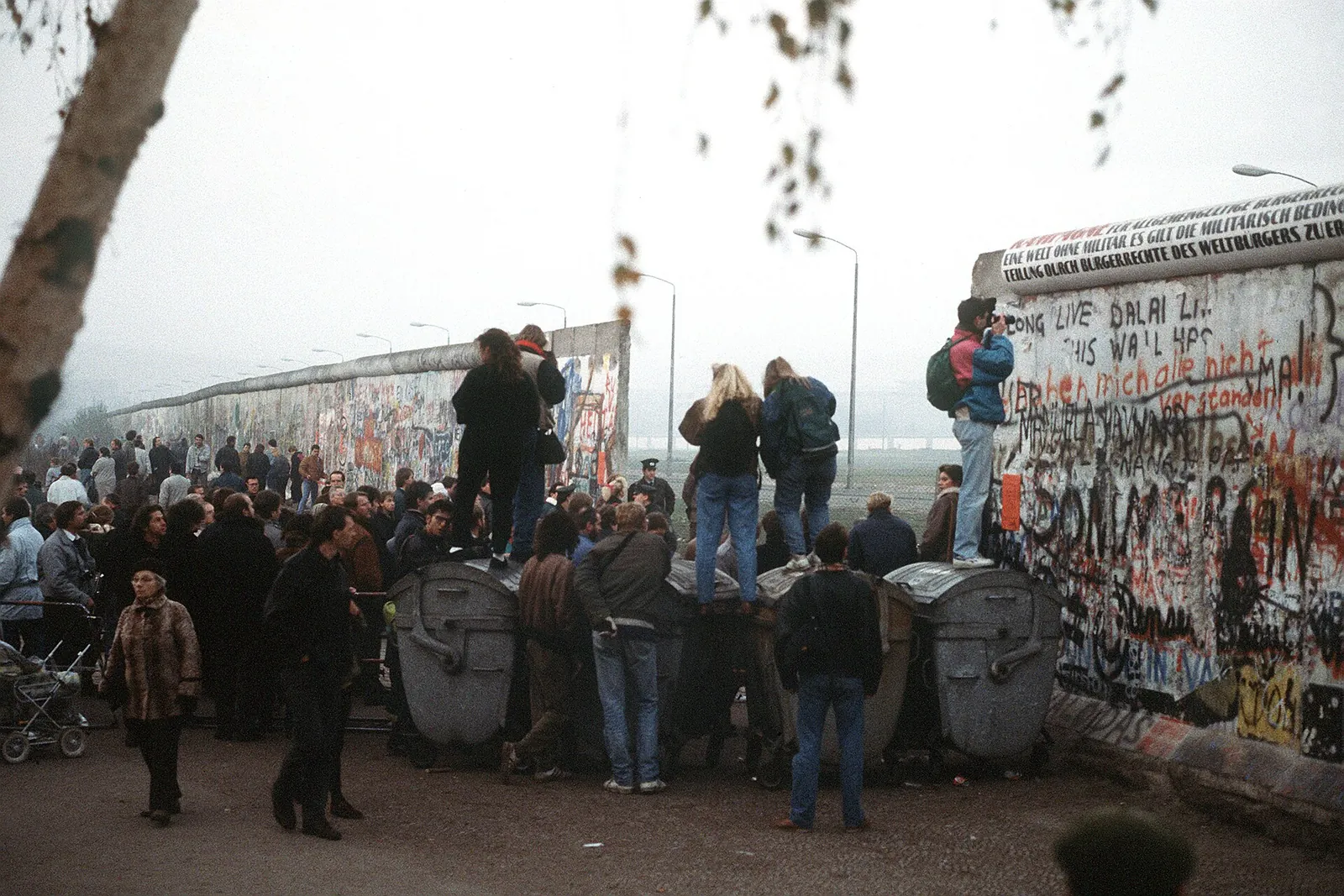
On 9 November 1989, crowds gathered at Berlin's border crossings after an announcement about new travel rules. Guards opened the checkpoints that night, allowing East Berliners to cross into West Berlin.
Which assumptions about political stability need revisiting when institutions begin to change?
Berlin.de · Opening and fall of the Berlin Wall· Sendai, Japan
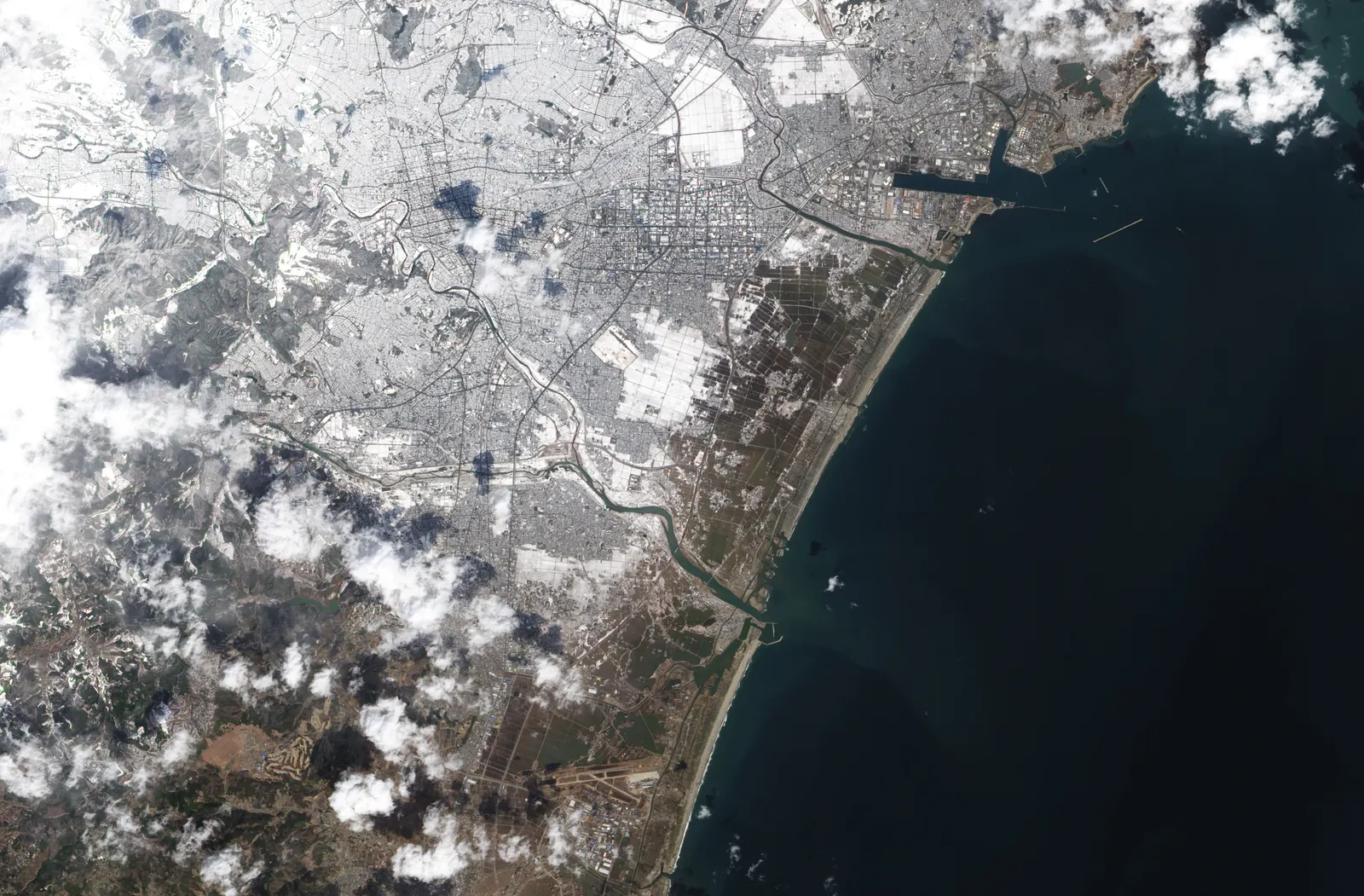
An offshore earthquake struck northeastern Japan on 11 March 2011, triggering a devastating tsunami. Satellite imagery a week later showed coastal fields near Sendai still covered by floodwater.
Where could a physical disruption expose dependencies beyond the immediate impact zone?
NASA Earth Observatory · Earthquake and Tsunami near Sendai· Suez Canal, Egypt
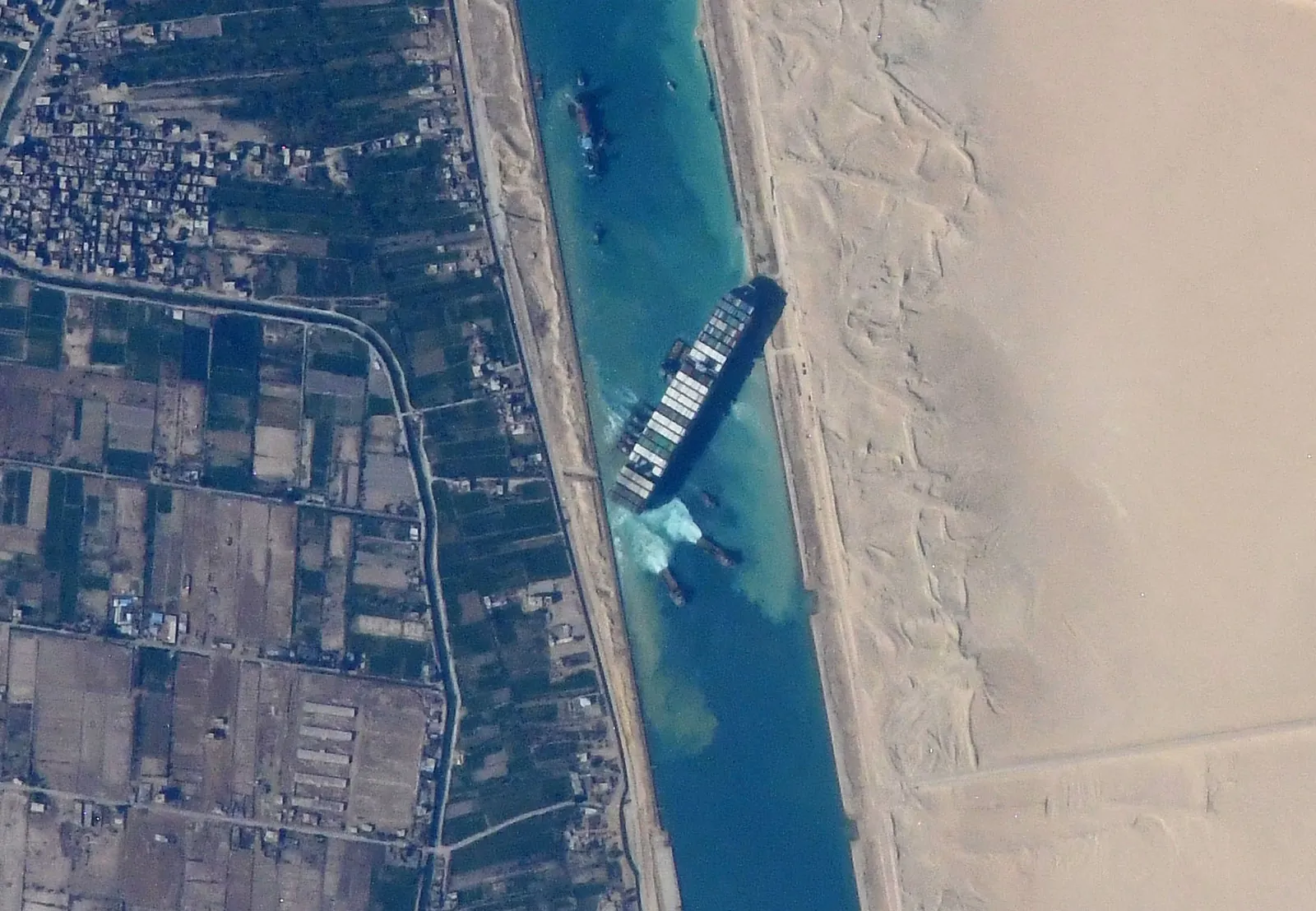
The container ship Ever Given blocked the Suez Canal for six days in March 2021. Hundreds of vessels waited as salvage crews worked to free it; the canal reopened on 29 March.
Which critical routes concentrate your exposure, and what changes if one becomes unavailable?
NASA Earth Observatory · Traffic Jam on the Suez Canal05 / Where thinking meets exposure
The same event can create very different questions. Select your team's perspective to see where a structured assessment belongs.
Bring defined transit, sanctions, and export-policy scenarios alongside your desk's own freight, inventory, and market views.
Define the route, policy threshold, and decision window.
Compare disruption and normalization scenarios.
Keep a dated assessment in the desk's shared review record.
For commodity desksGive portfolio managers and investment committees a common scenario to examine before debating the market implications.
Name the catalyst and the window in which it matters.
Examine both supporting and challenging evidence.
Bring a shared scenario set into the discussion.
For macro fundsFollow the policy or disruption question through its decision window.
Set an explicit event definition and resolution window.
Separate the initial event from downstream consequences.
Revisit the dated view when the thesis is challenged.
For event-driven teamsGive quote, renewal, and referral discussions a defined geopolitical scenario.
Specify the passage, government act, or threshold at issue.
Examine cited evidence alongside the contrary case.
Retain a dated assessment for the next review.
For insurance teams06 / The team
Our team brings mathematical olympiad experience, has deployed production systems at scale, and has worked where probabilities are priced every day. That combination shapes the product: estimates that are statistically honest, delivered on infrastructure a desk can depend on.
Production engineering from large-scale software and data platforms: reliable pipelines, reproducible releases, and systems that stay up when the news breaks.
Probabilistic modelling and calibration from quantitative trading, where every estimate is scored against what actually happens.
07 / A few useful answers
Current coverage is focused on China and East Asia. Other domain pages show question sets we can scope during an evaluation.
Yes. The interactive format walkthrough and sample assessment show an illustrative probability range and dated history.
We are working with institutional investment, commodity, and insurance teams that have a specific geopolitical question, time horizon, and decision to support.
Start by telling us the question your team needs to monitor. Qualified institutions can discuss a free, no-obligation pilot for one confirmed domain. Coverage and scope are agreed together.
Your next decision starts here
Bring the question your team needs to examine. Together, we can discuss the available coverage and what a focused evaluation would need to show.
Request access